


According to the latest news, California-based MATECH has signed a contract with a prominent defense contractor for the development of hypersonic missile housings for flight testing using the company's carbon-fiber-reinforced ZrOC (C/ZrOC) ceramic-matrix composites.In 2023, MATECH successfully produced 50 kilograms of ceramic-matrix composite material (CMC) for this year's program.
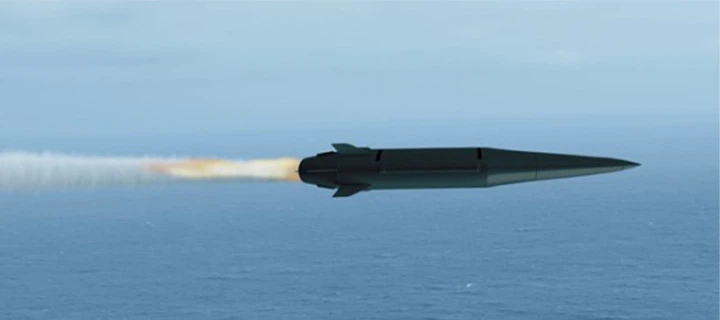
MATECH's development of ultra-high-temperature (UHT), highly dimensionally stable structural insulators helps to overcome the high-temperature challenges associated with hypersonic missile casings at high speeds; these missile casings become very hot when they are flown at hypersonic conditions, so the faster they fly, the hotter they get.
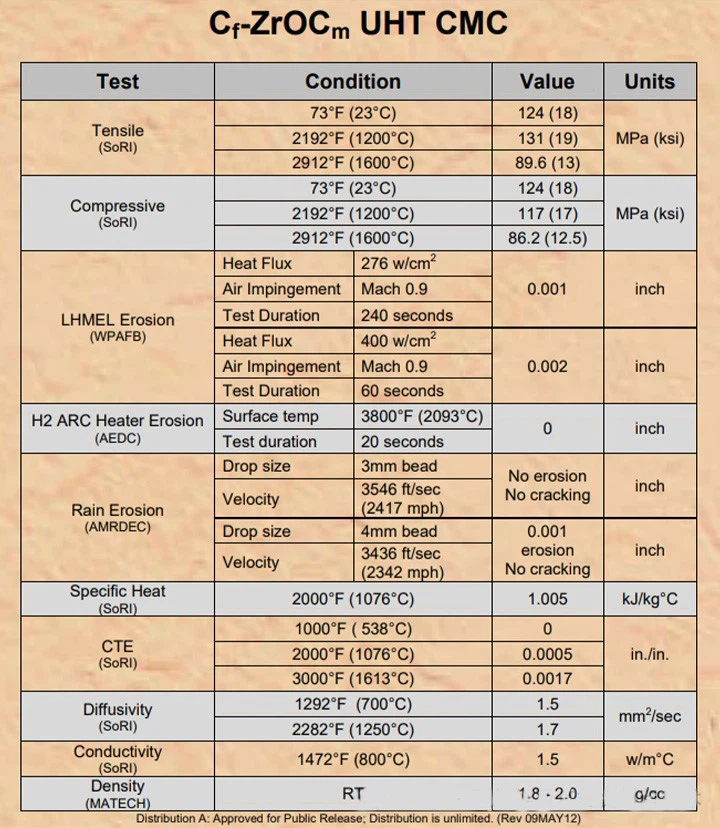
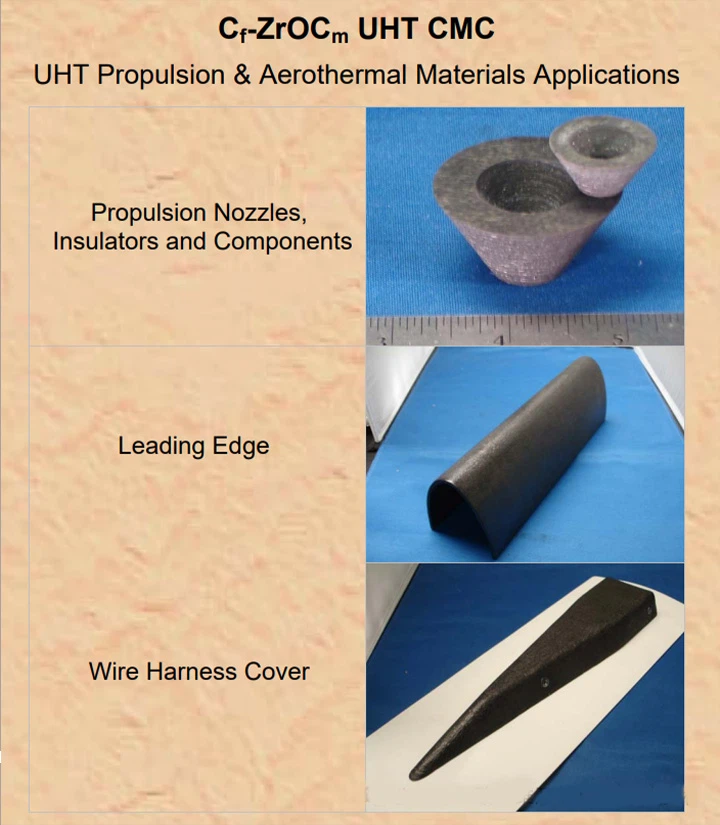
MATECH's C/ZrOC ceramic matrix composite is a low ablation hypersonic material that is low cost, scalable and easy to fabricate. It has been tested at temperatures upwards of 2760°C at extreme standstill pressures in multiple government laboratories. In addition, the company says the manufacturing cost of this ceramic-based composite is equal to or less than its heavier, less capable metal counterparts.
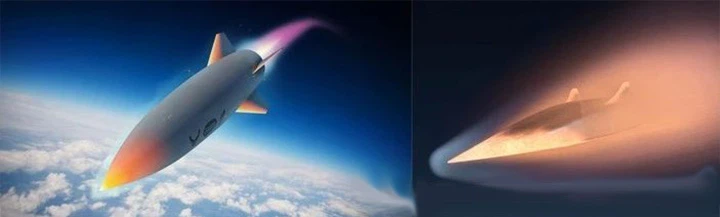
In addition to hypersonic missile casings for defense, MATECH's C/ZrOC Thermal Protection System (TPS) is ideal for reusable heat shields on commercial spacecraft. In addition, MATECH's C/ZrOC can withstand the extreme heat fluxes of lunar return and Mars return.
MATECH's Long-Term Commitment to Ultra-High Temperature Composites
Since its inception in 1989, MATECH has been committed to the commercialization of high and ultra-high temperature (UHT) ceramic fiber and ceramic matrix composite technologies.MATECH has developed a range of pre-ceramic polymers for the fabrication of Silicon Carbide (SiC), Silicon Nitride/Silicon Carbide (SiNC), Silicon Oxide Carbon (SOC), Silicon Nitride (Si3N4) and Hafnocene Carbide (HfC). All of these are used in high-temperature structural applications.
Hypersonic nose tips are arguably the most demanding ultra-high temperature (UHT) applications for missile materials. Maintaining shape is critical to missile operation. High-density thermally pressed ceramics such as silicon carbide provide the lowest oxidation and ablation rates. However, ceramics have poor thermal shock resistance and low toughness. In contrast, ceramic matrix composites (CMCs) offer high toughness.
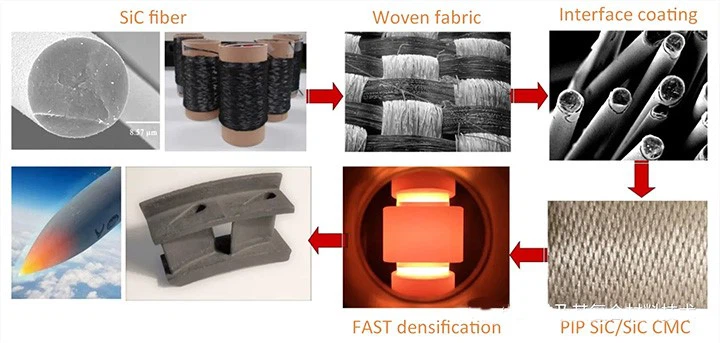
Currently the usual preparation method for ceramic matrix composites is to start with 40-50% density CMC and then use Field Assisted Sintering Technique (FAST), which ends up with densities that are far from 100% and perform very poorly as the fibers are destroyed. The company therefore recognized the need to be denser from the outset of the preform, with porosity down to 7-10%, which the company has since successfully demonstrated can be achieved in less than 10 minutes with up to 99.9% dense SiC/SiC with the strength and toughness expected of CMC.
Carbon-Carbon (C/C) composites were first developed in 1958 as a ballistic re-entry nose tip material, and while High Density Carbon-Carbon (HDCC) composites have excellent properties, they have very high ablation rates at high temperatures and stagnant flow pressures. Based on this MATECH developed a very low ablation rate hypersonic material, known as C/ZrOC composites that are low cost, mass-producible and easy to manufacture. With strong support from the U.S. Missile Defense Agency, MATECH has achieved pre-qualification status for hypersonic and missile defense applications for its Ultra High Temperature (UHT) C/ZrOC TPS and propulsion variants. These were specifically developed for high performance and ease of manufacture to meet critical defense and civil space needs.
And in January, MATECH announced that it has developed ultra-high density carbon fiber reinforced carbon matrix (C/C) composites. This groundbreaking new technology will make C/C composites 20 times more resistant to ablation and oxidation than currently available C/C materials, and is expected to be used in demanding nose and leading edge components such as hypersonic missiles and ballistic re-entry.