


MATECH has developed ultra-high-density carbon/carbon composite materials.
According to the latest announcement from MATECH, the company has successfully developed ultra-high-density carbon fiber-reinforced carbon-based (C/C) composites. This breakthrough technology enhances the ablative and oxidation resistance of C/C composites by 20 times compared to existing C/C materials, making them suitable for demanding applications such as high-speed missiles and ballistic reentry nose cones and leading edges.
MATECH will officially unveil this patented development project at the 47th Composite Materials, Materials, and Structures (CMS) Conference, held in St. Augustine, Florida, USA, on January 23, 2024. MATECH's Field-Assisted Sintering Technology (FAST) enables the production of dense C/C composites with unprecedented high density.
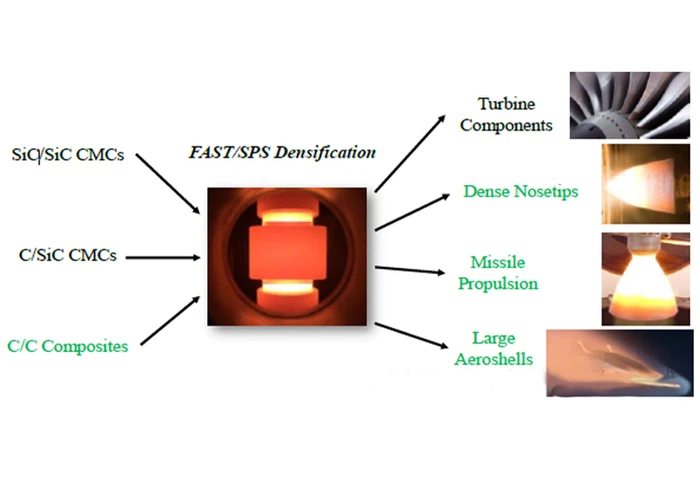
By employing this new process, MATECH has achieved a bulk density of over 2.20 g/cm3 for the C/C composites, which is very close to the absolute theoretical density of graphite (2.26 g/cm3). Additionally, a significant amount of fiber pullout was observed during fracture. The FAST carbon-carbon composites can be easily extended to the nose cones and leading edges of high-speed missiles. Moreover, the process is safe, cost-effective, and relatively straightforward. This patented technology (US Patents 10464849 and 10774007) expands on MATECH's previous work in rapid densification of SiC/SiC and C/SiC CMCs.
High-density C/C composites were initially used for ballistic reentry nose cones in the 1960s and 1970s. The high-density carbon, obtained through hot isostatic pressing and impregnation carbonization processes, replaced the dense monolithic graphite. However, these processes were associated with certain risks, high costs, and technical difficulties. Furthermore, the previous processes typically produced C/C composites with a maximum bulk density of 1.95 g/cm3, and no other process significantly increased the density of carbon-carbon composites.
Patented technology for high-density composite
Headquartered in California, USA, MATECH was founded in 1989 by Dr. Ed Pope. According to Pope, the company has been working on advancing 2700°F Ceramic Matrix Composites (CMCs) for more efficient turbine engines. However, the main approach has been starting with CMCs at 40-50% density and using Field-Assisted Sintering Technology (FAST), resulting in densities far from 100% and poor performance due to fiber damage. Therefore, the company realized the need for densification from the beginning with preforms, achieving reduced porosity to 7-10%. MATECH later demonstrated the ability to achieve dense SiC/SiC with densities up to 99.9% in less than 10 minutes, along with the desired strength and toughness of CMCs.


MATECH's patented process (top) utilizes standard Field-Assisted Sintering Technology (FAST) equipment (bottom), which applies pulsed current and pressure to CMC parts through molds, enhancing material reactivity and temperature through Joule heating.
To demonstrate the effectiveness of this process, MATECH started with simple geometries such as discs and rectangular plates. More complex geometries, like the aerospace engine double blade shown in the figure, can be produced in FAST molds using graphite tooling, which was originally designed for Prepreg-Integrated Pressure (PIP) but has not been used for creating FAST dense components. The FAST process time, pressure, and temperature for shaping parts are the same as those for flat geometries. Based on this research, Pope obtained two patents: one in 2019 for the process and another in 2020 for the material composition.
The densification of MATECH's SiC/SiC and C/SiC CMCs utilizes pressures ranging from 30 to 100 megapascals. This is the typical range used in FAST processing, with current levels ranging from 2,500 to 10,000 amperes, depending on the sample size. However, the current is concentrated in relatively short bursts, making it more efficient than conventional hot pressing techniques. Additionally, the heat is generated internally within the material, rather than being applied externally. By using current and mold pressure, the thermal energy is effectively increased while also introducing vibrational energy, making the material more reactive.